First contact with a prospective claim
A prospective personal injury client, at the point of first detailed contact. Whoever takes the enquiry completes it, with the client. It is not handed over for self-completion.
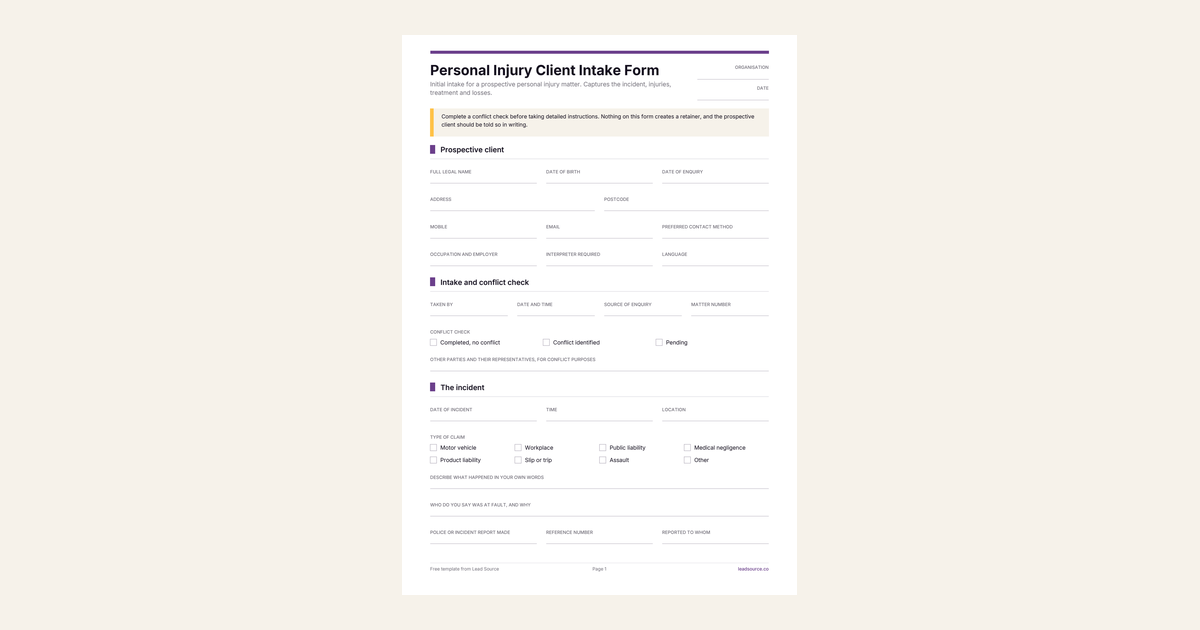
The form opens with a note stating that a conflict check comes before detailed instructions, and that nothing on the form creates a retainer.
Incident, injuries, losses and insurance
Prospective client details including interpreter requirements. Intake and conflict check, who took it, when, and source of enquiry, then matter number and conflict status, and a block for other parties and their representatives.
The incident, date, time and location, then claim type across eight categories, then a full open block for what happened, and who is said to be at fault, and whether a police or incident report was made with its reference.
Witnesses in a four-row table, and an evidence availability list.
Injuries and treatment, injuries sustained, then a five-row treatment table capturing date, practitioner, treatment and whether ongoing, then current symptoms and limitations, and pre-existing conditions affecting the same area.
Financial loss, insurance and prior advice, then an acknowledgement block and dual signature.
Conflict check before instructions, not after
The order on this form is deliberate. It is the opposite of how most intake conversations naturally run.
Someone calls, they want to tell you what happened, and the instinct is to listen. But you may be conflicted out of acting for the other side, once you have taken detailed instructions from a prospective client, and in some circumstances you have obligations to a person who never became your client.
The other parties block sits in the conflict section for exactly this reason, rather than in the incident section. Get the names first, run the check, then take the story.
Diarise the limitation date at intake
The form carries a note stating that limitation periods are strict. They vary by claim type and jurisdiction, and they should be diarised at intake before the file is opened.
The failure mode is well known and it still happens. An enquiry sits in a pile for three weeks while someone decides whether to take it, and the limitation clock is running the entire time. Recording the incident date and the earliest possible limitation date at the point of first contact costs nothing. It is the single highest-value thing on the form.
Pre-existing conditions
There is a specific field for pre-existing conditions affecting the same body area. It is there because the answer changes the matter substantially.
Clients frequently do not volunteer this. Sometimes because they do not think it is relevant, and sometimes because they worry it will hurt their claim. Discovering it from the other side's medical records is considerably worse, rather than from your own client.