Every new matter, any practice area
Any new enquiry at a law firm, across practice areas. It captures who the client is, and who else has an interest, then what the matter is, and on what basis you would act, and it ends with a recorded intake decision.
Parties, conflict check and engagement basis
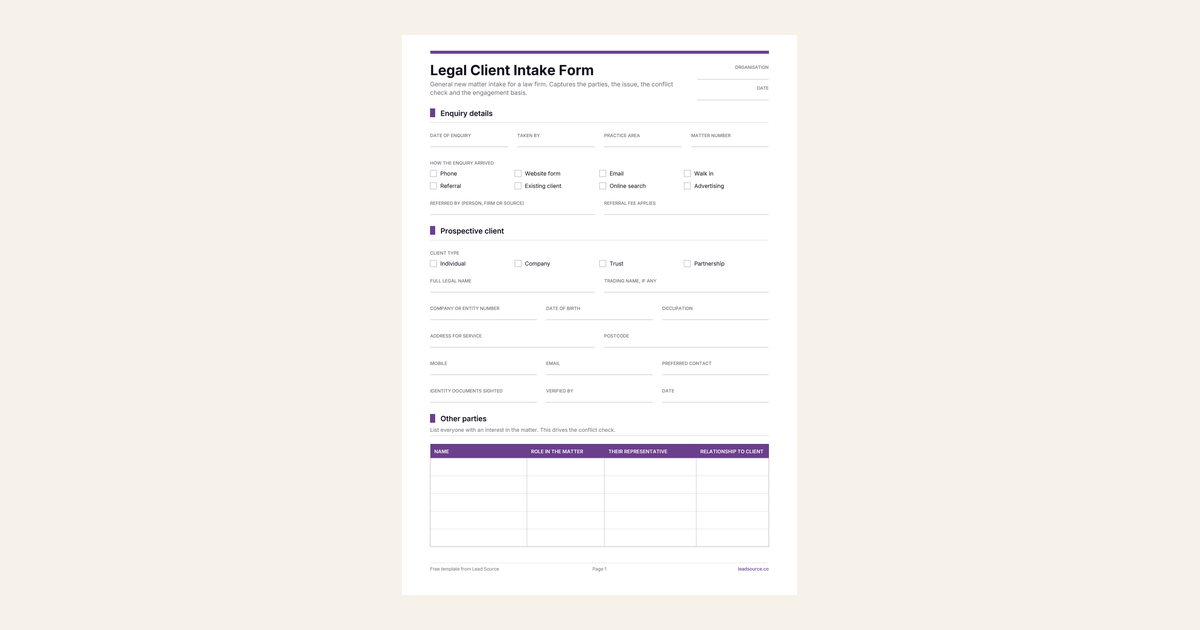
Enquiry details, date, who took it, and practice area, then matter number, and how the enquiry arrived across eight channels, and referral source with whether a referral fee applies.
Prospective client, client type across individual, company, and trust or partnership, then legal and trading name, entity number, and contact details, and identity documents sighted with who verified them and when.
Other parties in a five-row table. It captures name, role, their representative and relationship to the client, then the conflict check with status, and who searched, then when, and resolution notes.
The matter. That is a summary in the client's words, and desired outcome, then key dates and any limitation date, and urgency, then documents provided, proceedings status and court details.
Prior advice, then engagement basis, fee arrangement across seven options, and estimate given, then money on account, and costs disclosure sent, then intake outcome across four options with a reason and responsible lawyer.
The other parties table is the conflict check
Five rows, capturing each party's name and their role, then their representative, and their relationship to the client.
Name alone is not enough to run a useful conflict search. The role tells you whether a match matters. The representative matters, because you may be conflicted through the other side's firm, rather than the party, and relationship to the client catches the situation where a party is a family member or associated entity. The client did not think to mention that party.
Recording the intake outcome
Four options, accept and open file, or decline and send letter, then refer out, or pending partner review. Plus a reason and a named responsible lawyer.
Most firms record accepted matters well and declined enquiries barely at all. That asymmetry causes two problems. You cannot see what you are turning away, which is useful business information, and declined enquiries with no recorded outcome are the ones where the non-engagement letter never gets sent.
The form carries a note stating that a non-engagement letter goes to every declined enquiry, without exception.
Referral source is worth capturing properly
How the enquiry arrived, and the referring person or firm, both have fields. Plus whether a referral fee applies.
Most firms could not accurately state what proportion of new matters come from existing clients, or from referrers, or search, or advertising, because the information is known in conversation and never written down in a countable place. Capturing it at intake, consistently, is the only way that number ever exists.