See every page each lead visited before they converted
Customer journey tracking shows how people interact with your website once they arrive: where they go, the pages they consume, how long they spend, and the path that ends at the form. Tied to the named lead, captured automatically.
Free to start · no card

Integrates with the tools you already use.


The pages that did the selling, in order.
Every lead arrives with its journey attached: the landing page they entered on, each page they viewed after it, and the form they finally submitted. Not a sample, not a guess at a typical route. The actual pages that person read, in the order they read them.
The record is captured server-side at the moment of submission, so it survives ad-blockers, refused consent and stripped UTMs. See worked lead source examples for what a captured record looks like.
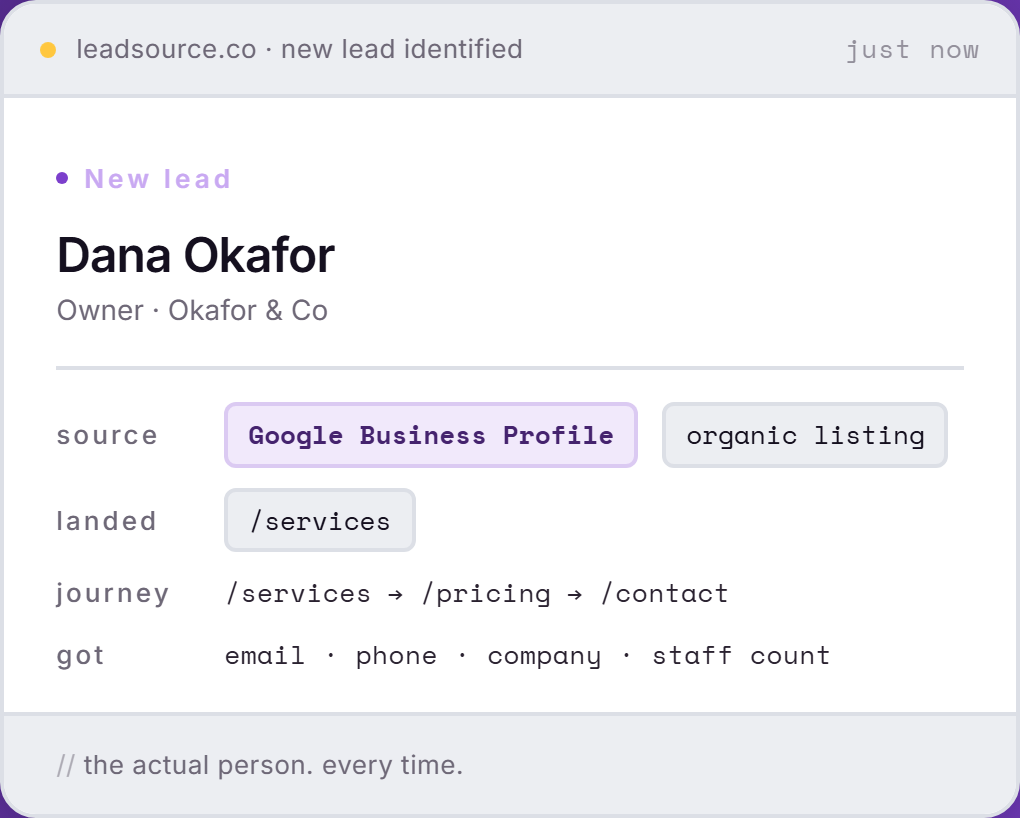
Where they go. What they read. How long they stay.
The dashboard already counts visitors, engaged time, pages per visit and conversions. Journey tracking ties those same measures to individuals. A lead is not a row in an aggregate. It is a person, a path, and the time they spent on each step of it.
Useful when two leads look identical in your CRM and one of them read six pages first. See the numbers side by side on the analytics dashboard.
The journey, attached to a name
A session path is anonymous. Lead Source keeps the route someone took and puts it on their lead record.
Tracking, not mapping.
A customer journey map is something a team draws: personas, stages, a workshop, a diagram of the route you believe people take. It is genuinely useful for planning, and it is a model.
Journey tracking is the other half. It records the route people actually took, one real lead at a time, so you can check the model against what happened. Both have a job. Only one of them is evidence.
What GA4 path exploration can’t tell you.
GA4 path exploration shows anonymous routes in aggregate: how many sessions went from one page to another. It answers what a population did. It cannot tell you which pages the person who just enquired had read, because it was never holding a name.
Journey tracking answers the individual question instead, and the two sit together happily. See the fuller comparison on Lead Source vs Google Analytics.
Three steps, then it runs itself.
One line of code.
A single script tag in the head of your site. Every form on every page is tracked from then on, with no per-form configuration.
Captured at submission.
When someone submits, the source, the landing page and the full page journey are recorded server-side, at the moment it happens.
Lands named in your CRM.
The lead arrives as a real person with the journey attached, in HubSpot or Salesforce, through a webhook, or in the Lead Source dashboard with no CRM at all.
Works with whatever form tool you already use. See lead source integrations.
Customer journey tracking, questions answered.
Is this the same as customer journey mapping?
No. Mapping is a diagram your team draws of the route you think people take. Journey tracking records the route each real lead actually took, so you can check one against the other.
How is this different from GA4 path exploration?
GA4 shows anonymous paths in aggregate, so it answers what a population did. Journey tracking shows the pages one named lead read before they submitted your form. See the fuller comparison.
Do I need to set up events or goals?
No. One script tag in the head of your site tracks every form on every page. There is no per-form configuration and nothing to maintain.
Does it work with my form tool?
Yes. It works with any form tool, and the named lead writes into HubSpot, Salesforce, Close, Keap, Pipedrive, a webhook, or no CRM at all. See all integrations.
Know what every lead read before they enquired.
One line of code on the forms you already have. Every lead arrives with the pages they consumed and the path that ended at your form.
See pricingFree to start · no card