Read this before you use it
Botulinum toxin is a prescription medical treatment. This template must be reviewed and adapted by the prescribing practitioner and your indemnity insurer before use. It must reflect the law where you operate. Prescribing rules vary significantly by jurisdiction. So do the rules on who may inject. So do the rules on what consent must contain.
The form carries that warning as its first block, on the page. So nobody downstream mistakes a downloaded template for a compliant one.
Screening, risks and the treatment record
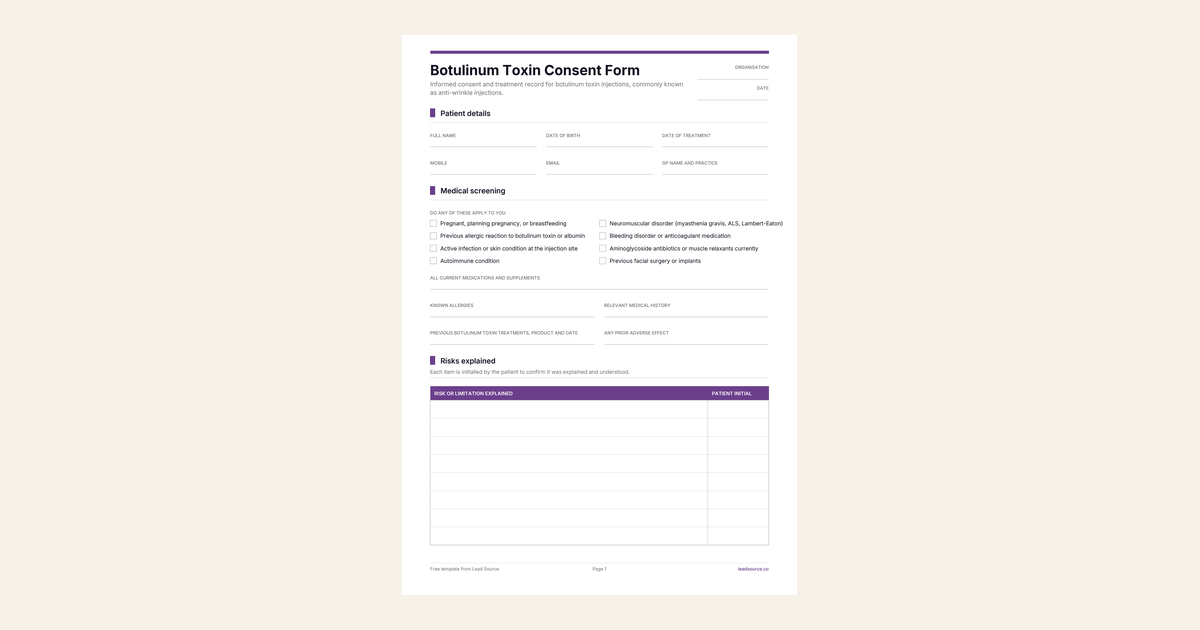
Patient details including GP. A medical screening list covering the contraindications specific to botulinum toxin. It covers pregnancy or breastfeeding, neuromuscular disorders, and previous allergic reaction to the toxin or to albumin, then bleeding disorders or anticoagulants, active infection at the site, and aminoglycoside antibiotics or muscle relaxants, then autoimmune conditions, and previous facial surgery or implants, then medications, allergies and history, then previous treatments with product and date.
A risk acknowledgement table with nine rows, each initialled by the patient.
A treatment record. It has product and brand, batch number, expiry and dilution, then a per-area table capturing treatment area, units, injection points and notes. Total units, prescribing practitioner and injector are recorded separately.
Aftercare, then a consent block, then dual signature.
Why the risks are a table you fill in
The risk table is deliberately blank. It has a note listing what is typically discussed, rather than pre-printing the risks into the rows.
A pre-printed list with one signature at the bottom evidences that a document was signed. An initial against each line evidences that each item was discussed with this patient.
The note tells you what typically belongs there, bruising, swelling and tenderness, then headache, asymmetry, and eyelid or brow droop, then temporary weakness of nearby muscles, and treatment failure or reduced effect over time, then the two-week review, and that results are temporary.
Batch numbers are not administrative detail
Product, brand and batch number all have their own fields. So do expiry and dilution. The treatment table records units per area, rather than a single total.
Two reasons. If a product recall occurs, you need to identify every patient treated from an affected batch. You cannot do that from a total dose written on a consent form, and the per-area unit record is what lets you work out what happened, rather than reconstructing it from memory, if a patient returns reporting an unusual outcome.
Prescriber and injector are recorded separately, because in many jurisdictions they are different people with different responsibilities, and a single "practitioner" field obscures that.
Photography consent is separated
The consent block includes agreement to clinical photographs for the medical record. Marketing use is a separate tick with separate written consent required.
Bundling them is common and it is a mistake. A patient consenting to a clinical photograph for their file has not consented to appearing on your social media. Treating one signature as covering both is the kind of thing that produces a complaint with no defence.