Health history before the first session
A new client at a massage therapy practice. It captures health history and contraindications, then the reason for the visit, and treatment preferences, then a therapist notes section that continues across visits.
Contraindications and session notes
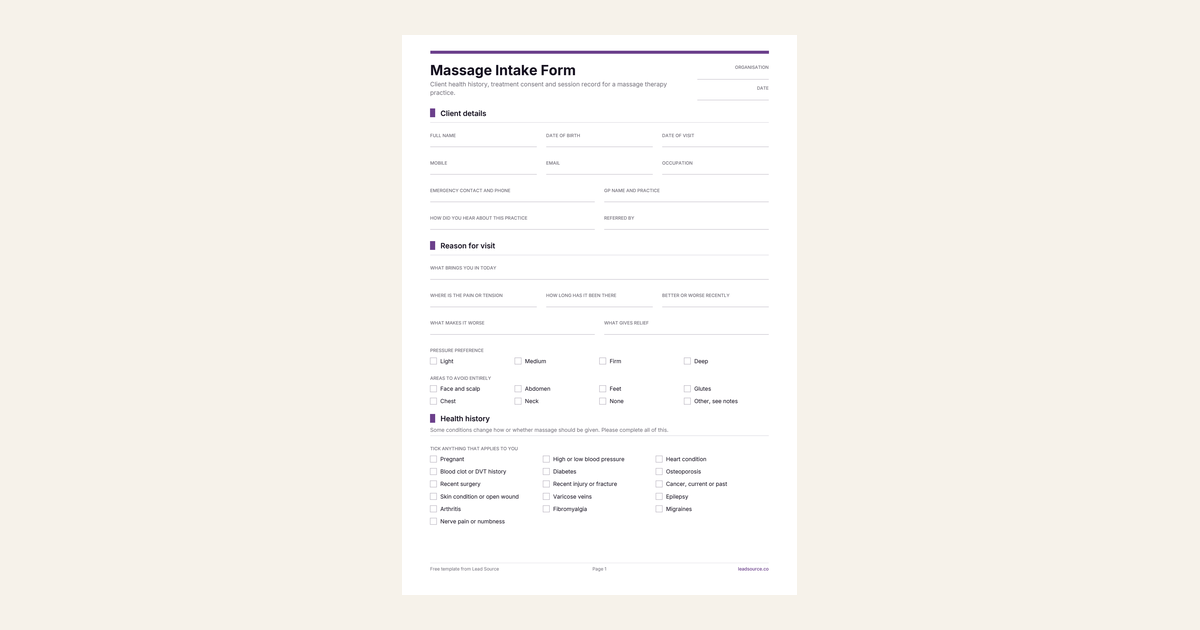
Client details, emergency contact, GP and how they heard about the practice.
Reason for visit. That is what brings you in, and where the pain or tension is, then how long, and whether it is improving, then what makes it worse and what gives relief, then pressure preference and an areas-to-avoid list.
Health history uses a sixteen-item contraindication list. It covers pregnancy, blood pressure, and heart condition, then clot or DVT history, diabetes, and osteoporosis, then recent surgery, recent injury or fracture, and cancer. Then skin conditions or open wounds, varicose veins, and epilepsy, then arthritis, fibromyalgia, migraines and nerve pain, then a details block, medications, and allergies including oils and nuts, then previous massage experience.
Therapist notes, observations, techniques used, and areas treated, then client response and aftercare, and recommended follow-up, then a six-point consent block and dual signature.
The two questions that change the first session
Pressure preference and areas to avoid, both as explicit tick lists rather than something to raise in the room.
Clients routinely do not speak up mid-treatment. Someone who finds the pressure too much will often lie there and endure it, then not rebook and never say why. Asking on paper beforehand gives them a low-stakes way to answer, and gives you a documented starting point.
Areas to avoid does similar work. Some people do not want their feet touched. Some do not want anything near the abdomen, and some have a reason they would rather not explain. A tick list means they do not have to.
Allergies means oils
The allergy field specifically prompts for oils, nuts, latex and fragrance rather than asking generically.
Nut-derived carrier oils are common and a client with a nut allergy will not necessarily connect "do you have any allergies" with the almond oil about to go on their skin. Prompting for the category gets the answer.
The consent block is about the session, not liability
Six acknowledgements. That the information is accurate, that massage is not a substitute for medical diagnosis or treatment, and that the client will speak up during the session if pressure is uncomfortable. Then that draping is used throughout and the session can be stopped at any point, that they will update you on health changes, and that they have read the cancellation policy.
The draping and stop-at-any-point line is the important one. Stating it in writing at the start makes it far easier for a client to actually use, which is the entire point of having it.