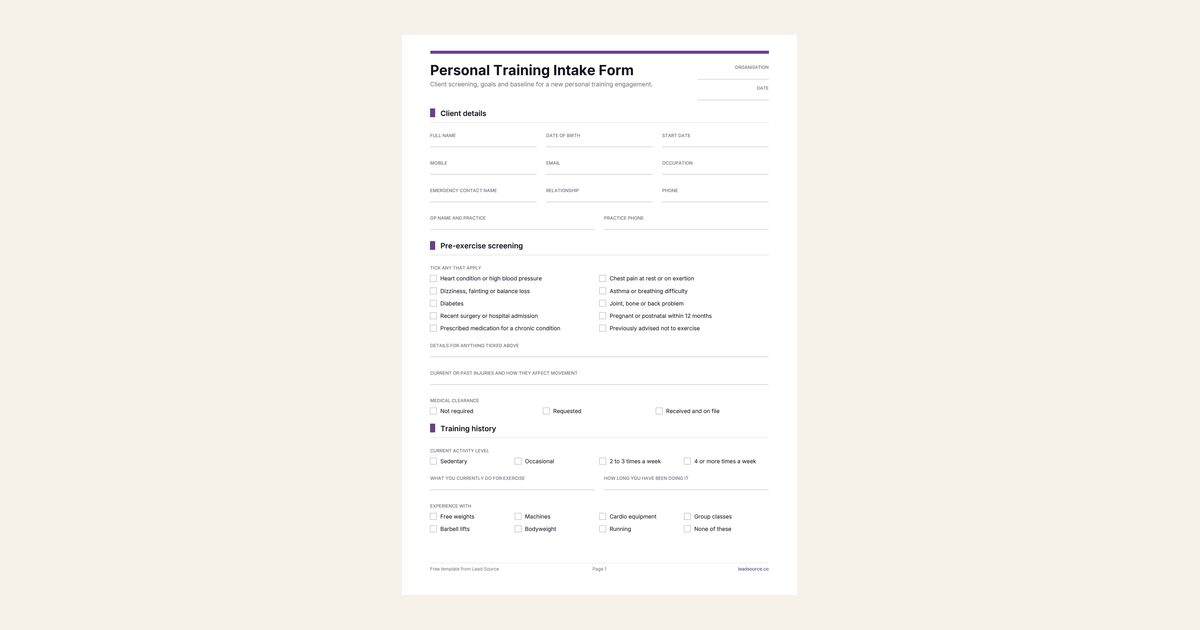
Screening and programme design
A new one-to-one client. It covers screening and injury history, which you need for safety, then training history and constraints, which you need to write a programme they will actually do.
It is not a waiver. You need one of those as well, if you operate independently rather than inside a gym that already holds a signed waiver.
Injury history, goals and constraints
Client details, emergency contact and GP. A ten-item screening list, then a details block, then a dedicated block for current or past injuries and how they affect movement, then a medical clearance status.
Training history, current activity level, what they do now, and how long, then an eight-item experience list. That covers free weights, machines, and cardio, then classes, barbell lifts, and bodyweight, then running or none, and then what they have enjoyed and what they have hated.
Goals. That is what they want in their own words, why now, and how they will know it worked.
Practical, sessions per week, preferred times, and location, then equipment available between sessions, and realistic time for training outside sessions, then sleep, stress, and occupational demands, and what has derailed their training before.
"What have you hated" earns its place
Most intake forms ask about experience and stop. Asking what someone has enjoyed and what they have hated changes the programme you write.
Somebody has hated every group class they have attended and hated running. They are telling you the two things most likely to make them quit. You can build a perfectly sound programme around either and it will not matter, because they will stop going.
Same logic behind "what has derailed your training before." The answer is usually specific and repeatable, a shift roster, and a knee that flares up, then January enthusiasm that dies in March, and a training partner who moved away. Knowing it in week zero means you can design around it.
The injury block is separate from screening
Screening is a tick list. Injuries get their own open block asking not just what the injury was but how it affects movement.
The distinction matters because "old shoulder injury" tells you nothing actionable. And "cannot get the left arm overhead without pain" changes what you programme on day one. Ask for the functional consequence, not the diagnosis.
Measurements are deliberately not on this form
The form carries a trainer note saying to keep physical measurements on a separate progress record, and to agree with the client which measures they want tracked before taking any.
Putting weight and measurements on the intake form makes them the frame for the whole engagement, before anyone has discussed whether that is what the client wants tracked. Some clients want it, some very much do not, and asking is a thirty-second conversation that avoids a bad start.