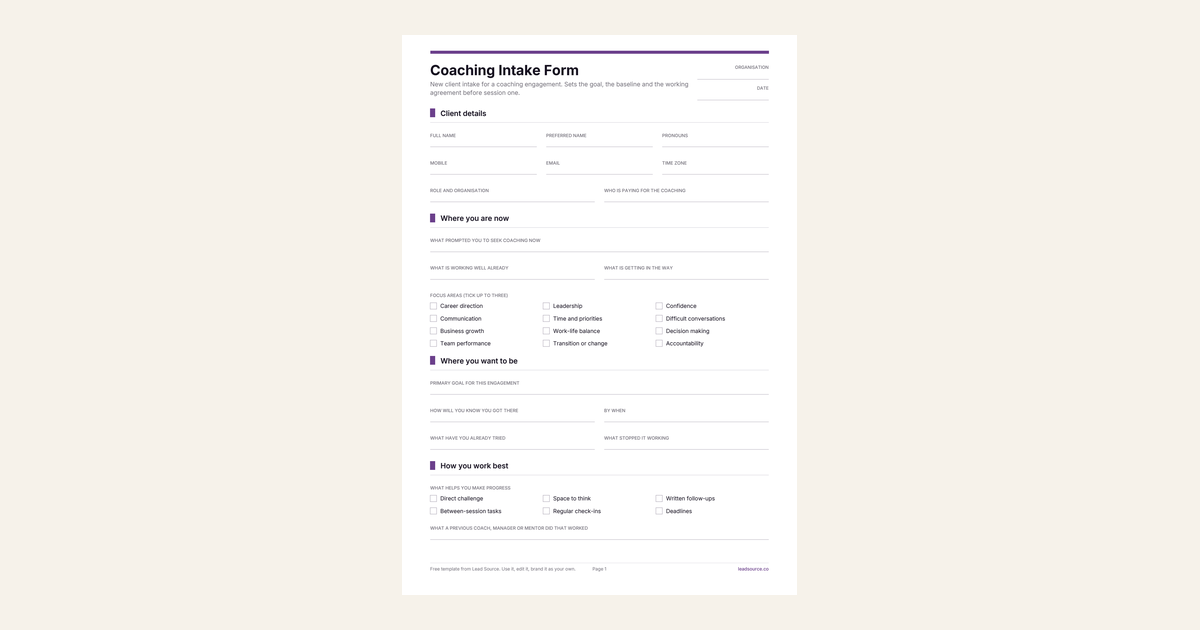
Where they are, where they want to be
A coaching engagement, whether executive, business or life coaching. It does three jobs. It establishes where the client is now, then defines what success looks like, and agrees how the two of you will work.
The third job is the one most coaching intakes skip, and it is the one that prevents most engagements that go badly.
Goals, working style and the agreement
Client details including who is paying for the coaching, a meaningful distinction when an employer is the sponsor.
Where you are now. That is what prompted this, and what is working already, then what is getting in the way, and a twelve-item focus area list capped at three selections.
Where you want to be. That is the primary goal, and how you will know you got there, then by when, and what has already been tried, and what stopped it working.
How you work best. That is what helps you make progress, then what a previous coach or manager did that worked, and what you would rather I did not do.
Logistics, then a four-point working agreement, then dual signature.
The cap of three focus areas
The focus list allows twelve options and instructs the client to pick up to three. The cap is deliberate.
A client who ticks nine focus areas is telling you something real, which is that they do not know what the problem is, a legitimate starting point. But it is a different engagement from one with a defined goal, and it should be named in session one, rather than discovered in session five when nothing has moved.
Forcing the choice at intake makes the ambiguity visible immediately.
"What you would rather I did not do"
This question is rare on coaching intake forms, and it prevents early terminations.
People have had bad experiences with coaches, managers and mentors, and they arrive with specific things they will not tolerate. Being pushed to set goals they did not choose. Being given homework. Being asked to talk about their childhood. Being told to be more confident.
Asking directly means you find out in week zero instead of week four, and clients answer it honestly, because the question gives them permission to.
The boundary against therapy
The working agreement opens with an acknowledgement, that coaching is not therapy, counselling or clinical treatment. That line is the most important one on the form, boilerplate or otherwise.
Coaching conversations reach material that belongs in therapy with some regularity. Having stated the boundary in writing at the start makes it far easier to name in the moment and refer on, because you are referring to an agreement you both signed. Rather than introducing a limitation the client has not heard before.