Read this before you use it
Waiver enforceability varies significantly by jurisdiction, and in some places a waiver cannot exclude liability for negligence at all. Have a lawyer review and adapt this before you rely on it. The form carries that warning as its first block on the page.
What a waiver reliably does everywhere is evidence that specific risks were disclosed, and that specific health questions were asked and answered, worth having regardless of how the liability clauses land.
Screening, waiver and membership terms
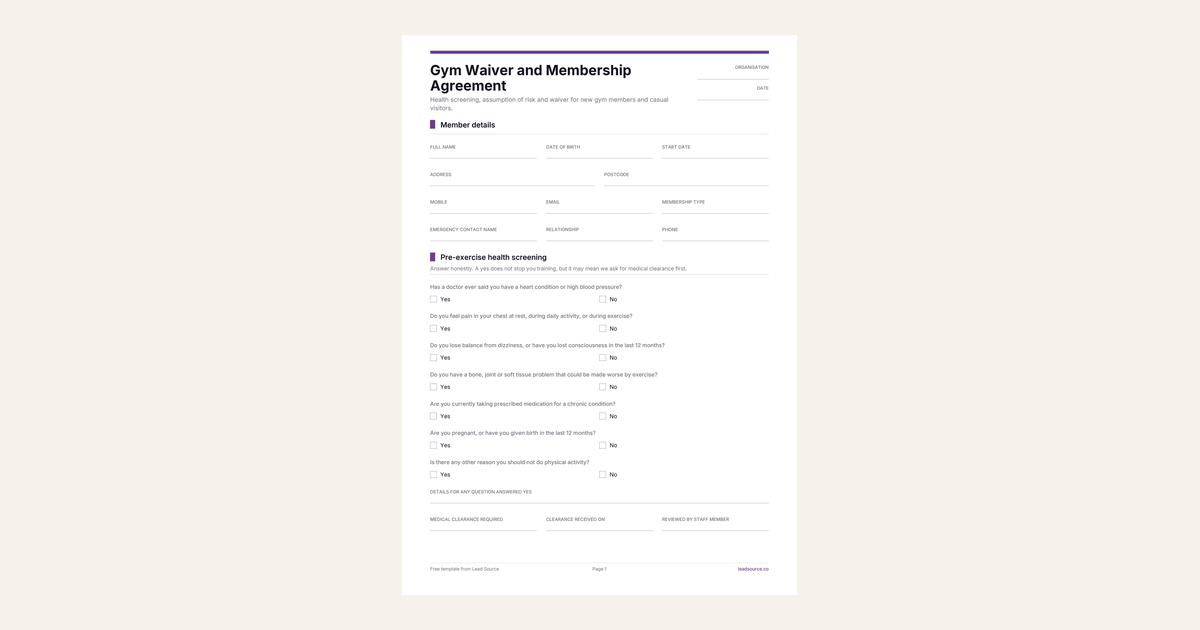
Member details and emergency contact, then seven pre-exercise screening questions as yes or no. They cover heart condition or high blood pressure, and chest pain, then dizziness or loss of consciousness, and bone joint or soft tissue problems, then prescribed medication for a chronic condition, and pregnancy or recent birth, and any other reason not to exercise. Followed by a details block, then fields for whether medical clearance was required, and when it was received, and which staff member reviewed it.
Then a seven-point assumption of risk and waiver block, then a membership terms acknowledgement, and a member signature, and a separate guardian signature block for under-18s.
The screening questions are not a formality
The seven questions are a recognisable pre-exercise screening set. They are worded as questions rather than a tick list. The reason is that a yes needs to trigger something.
The form says explicitly that a yes does not stop you training but may mean clearance is needed first. That framing gets more honest answers than a list that reads like a gate, because members who suspect a yes will cost them their membership tick no.
The three fields that follow are what turn the screening into a process, clearance required, clearance received, reviewed by. Without them a yes gets written down and nothing happens, which is arguably worse than not asking.
Membership terms as an acknowledgement, not a wall of text
The membership block is six ticked acknowledgements. They cover minimum term, payment method, and cancellation and suspension, then fee changes, access hours, and guest policy. It is not the terms themselves.
The full terms belong in a separate document. What this does is record that each category was drawn to the member's attention. That is far more defensible than a signature under four pages of small print that nobody claims to have read.
The guardian block
A separate signature block for under-18s. It is worded so the guardian confirms they have read the agreement, then consent to participation, and accept the terms on the member's behalf.
Whether a guardian signature is sufficient varies by jurisdiction, and in some places a minor cannot be bound by a waiver at all regardless of who signs. This is one of the specific things to raise with the lawyer reviewing it.