Clinical background and real context
A dietitian or nutrition practice taking a new client. It is completed before the initial consultation. It captures the clinical background you need, and the practical context that determines whether any plan you write will actually be followed.
Medical history and the usual intake table
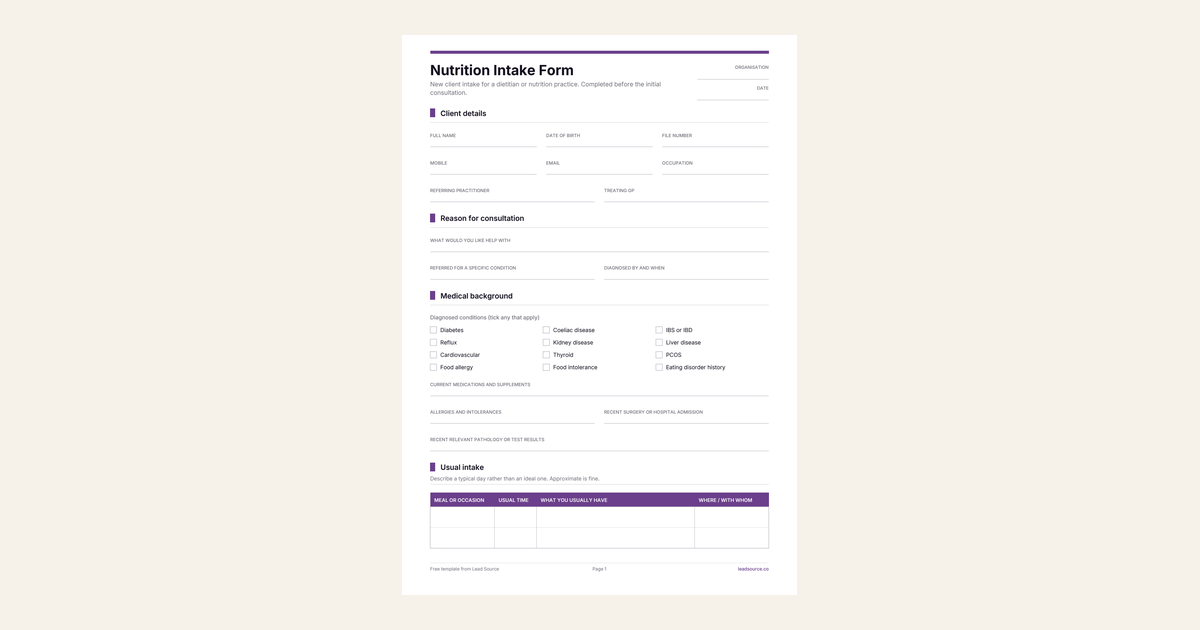
Client details, referring practitioner and treating GP. Reason for consultation, both open and by referred condition.
Medical background uses a twelve-item tick list. It covers diabetes, coeliac, and IBS or IBD, then reflux, kidney and liver, then cardiovascular, thyroid and PCOS, then food allergy, food intolerance and eating disorder history, then medications and supplements, allergies, and recent surgery, and recent pathology.
The usual intake table has six rows across four columns, meal or occasion, usual time, and what you usually have, and where or with whom, then fluids, alcohol and caffeine.
Habits and context is the section that earns the form its place, who shops and cooks, cooking confidence and time available, then budget or access constraints, and cultural or religious practices, then foods avoided and why, and foods they would not give up, then activity, sleep, and previous approaches tried and how they went.
Ask for the usual day, not the ideal day
The instruction on the intake table says to describe a typical day, rather than an ideal one, and that framing matters. A food diary completed with an audience in mind produces a document. That document is about who the client would like to be.
The "where and with whom" column does more work than it looks like it should. Eating alone at a desk, eating with children. Eating in a truck, eating after a night shift. Those facts determine which recommendations are realistic far more than the food itself does.
Why context beats precision
The most common failure in nutrition practice is a plan that is nutritionally right and unfollowable, because it assumed thirty minutes of cooking time that does not exist, or a food budget that does not exist, or a household where one person's requirements do not have to work alongside four other people's.
That is why "foods you would not want to give up" is on the form. A plan built around what someone will actually keep doing beats an optimal plan they abandon in nine days.
The screening note
The form carries a practitioner note instructing you to screen for disordered eating in session, using a validated tool, before setting any numeric targets, and to follow your referral pathway where a history is disclosed, rather than proceeding with a standard plan.
The template deliberately contains no numeric targets. It contains no goal weight field and no calorie prompts. If you adapt it, think carefully before adding them. A form that asks a new client to write a goal weight before anyone has assessed them is doing something you may not intend.