Who signs in, and when
One sheet, one site, one day. Everyone who comes through the gate signs in on arrival and signs out on departure. That includes deliveries, inspectors, sales reps and the client. The moment you start treating some categories of person as not needing to sign in, the sheet stops being a roll call, and becomes a rough attendance guess.
That distinction is the whole reason the format matters. A sign-in sheet has two jobs. The everyday job is knowing who is on site so you can find them, bill them or account for them. The rare job is standing at the assembly point during an evacuation and reading names off a clipboard. The second job is the one that determines the design, because it only works if the sheet is complete and current at every moment of the day.
Fields on the daily sheet
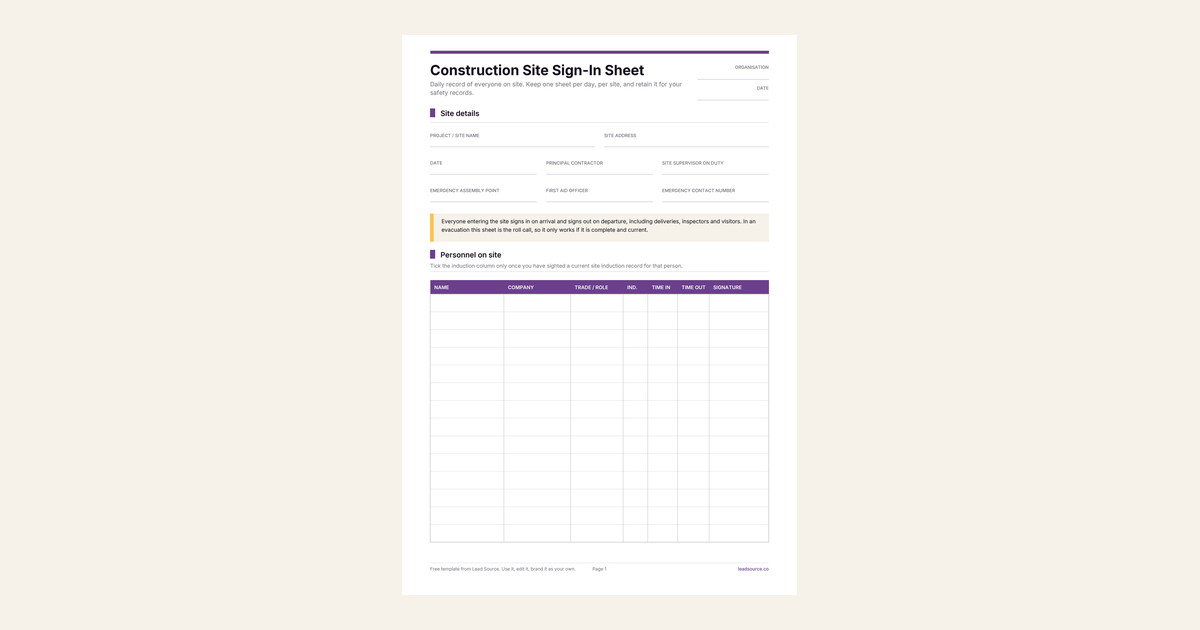
The header captures the project, the site address, and the date, then the principal contractor and the supervisor on duty. Underneath that sit three fields most sign-in sheets leave off. That is the emergency assembly point, the first aid officer, and an emergency contact number. They belong on the sheet itself, rather than on a poster by the gate, because in an evacuation the sheet is the thing someone is already holding.
The main table has seven columns, name, company, and trade or role, then induction, time in, and time out, and signature. The induction column is a tick, and it should only be ticked once you have actually sighted a current induction record for that person. A ticked box that means "probably fine" is worse than an empty one, because it converts an unknown into a false record.
The second page carries the overflow rows, and an end of day check, then a supervisor declaration confirming the record is true and complete.
What to leave out
Do not add a column for hours worked. Sign-in times are not timesheet data. They get rounded and estimated by whoever fills the gap at the end of each day, and once payroll depends on the sheet, people start writing what they want the time to be, rather than what it was. Keep timesheets separate.
Do not add a column for what work each person did. It sounds useful and it never gets filled in, and a mostly empty column trains people that the form is optional.
Where these usually go wrong
Sign-out. People sign in because there is a clipboard and a supervisor at the gate, then walk off site at four without going near it. By the end of the week half your rows have a time in and no time out, and the sheet is useless for its one important purpose.
There is no clever fix for this on paper. Two things work. Physically place the sheet where people have to pass it on the way out. Then have the supervisor walk the sheet at the end of each day, and close out the open rows before signing the declaration. The end of day check on page two exists to force that second habit.