Moving sign-in off paper
This one is different from the other five. It is mainly the specification for the sign-in you are about to build or buy, then a printable fallback on the second half.
The fallback is not a joke. Almost every site that goes digital keeps a paper sheet in the drawer, because a kiosk that will not load is a site that cannot open, and the alternative to a fallback sheet is a supervisor writing names on the back of an envelope.
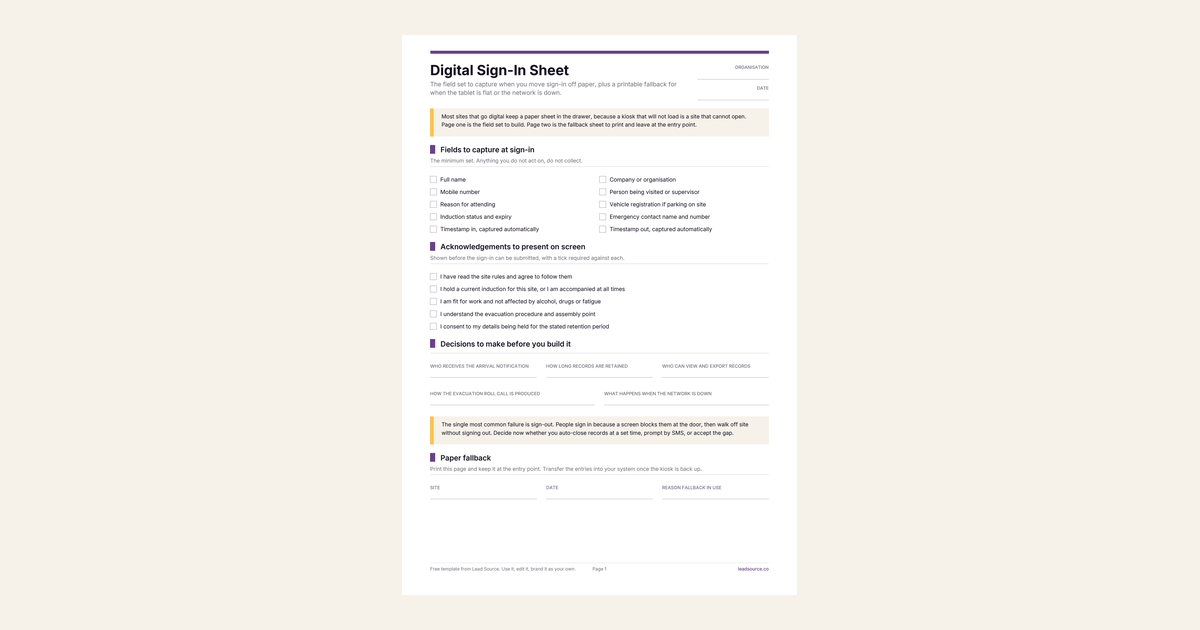
The field set
Ten fields, and the rule is that anything you do not act on should not be collected. Full name, company, and mobile number, then person being visited or supervisor, and reason for attending. Then vehicle registration if parking on site, and induction status and expiry, then emergency contact name and number, and timestamps in and out captured automatically.
Two of those deserve comment. Induction status and expiry is the field that makes a digital system worth having, because a kiosk can check it against a record and refuse entry. A clipboard cannot, and the timestamps should be system-generated rather than typed, since the entire reason to leave paper is to stop people writing approximate times.
Acknowledgements to show on screen
Five, each requiring a tick before the sign-in can submit, agreement to follow site rules, then confirmation of a current induction or of being accompanied, and a fitness for work declaration, then understanding of the evacuation procedure and assembly point, and consent to the retention period.
Presenting these on screen is one of the genuine advantages over paper. On a clipboard the conditions of entry are a paragraph at the top that nobody reads. On a screen they are a gate that has to be passed.
Decisions to make before you build it
Five questions that are much cheaper to answer now than after launch, who receives the arrival notification, and how long records are retained, then who can view and export records, and how the evacuation roll call is produced, and what happens when the network is down.
The roll call question is the one that catches people out. A digital system holds the data. But during an evacuation the person at the assembly point needs a list in their hand or on their phone, offline, immediately. The system has failed at the job that mattered most. That is if producing that list requires logging into a dashboard on a laptop that is inside the building you just evacuated.
Sign-out is still the problem
Going digital does not fix sign-out. People sign in because a screen blocks them at the door, and there is no equivalent barrier on the way out. Sites that go digital and do not plan for this end up with cleaner data about arrivals, and exactly the same gap on departures.
The three options are auto-closing records at a set time, then prompting by SMS after a set duration, or accepting the gap and documenting that you have. Pick one deliberately. The failure is choosing none of them and discovering the problem six months in.